Alessandro Scarlatti, father of the more well-known Domenico, has been a name for me ever since high-school music classes. There he was described as the most important representative of Neapolitan opera, which was essentially the form of opera which Gluck and his confrères in Vienna attempted to reform half a century later. However, I had never heard a note of his music until last night.
It was a revelation. In the care of Pinchgut Opera’s director, Erin Helyard, this music, formulaic as it indeed is in some respects, sprang off the page into an experience rich in emotions, whether in gorgeous tunes or wrenching chromatic harmonies. Helyard has fleshed out the score, which consists simply of vocal lines and figured bass, with a few violin lines thrown in here and there, into a sound web which, despite the absence of any woodwind or brass, never ceased to enchant. In particular the continuo section Helyard put together, including harp, theorbo, harpsichords and even a snarling regal to underscore Lucifer, was used with a finesse that, without departing even a fraction from the sounds Scarlatti might have expected, gave rise to subtle, constantly changing textures that did full justice to the changing moods of Scarlatti’s work.
In my review of Pinchgut’s The Faery Queen I commented unfavourably about the suitability of the acoustic of the Roslyn Packer Theatre for opera. Somehow the company have addressed this problem very successfully. While still lacking in the resonance of their old home, the City Recital Hall, the music was very well balanced, and the orchestral sound had a real bloom to it.
As I mentioned, the music of The First Murder is formulaic. Each aria or duet begins with a brief ritornello, followed by a double statement of the first line of the aria, then a B section, always in the relative minor, before a short cadenza leading to a da capo, all of which were ornamented in sometimes breathtaking ways in this production.
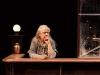
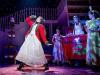
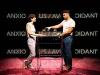
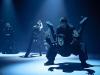
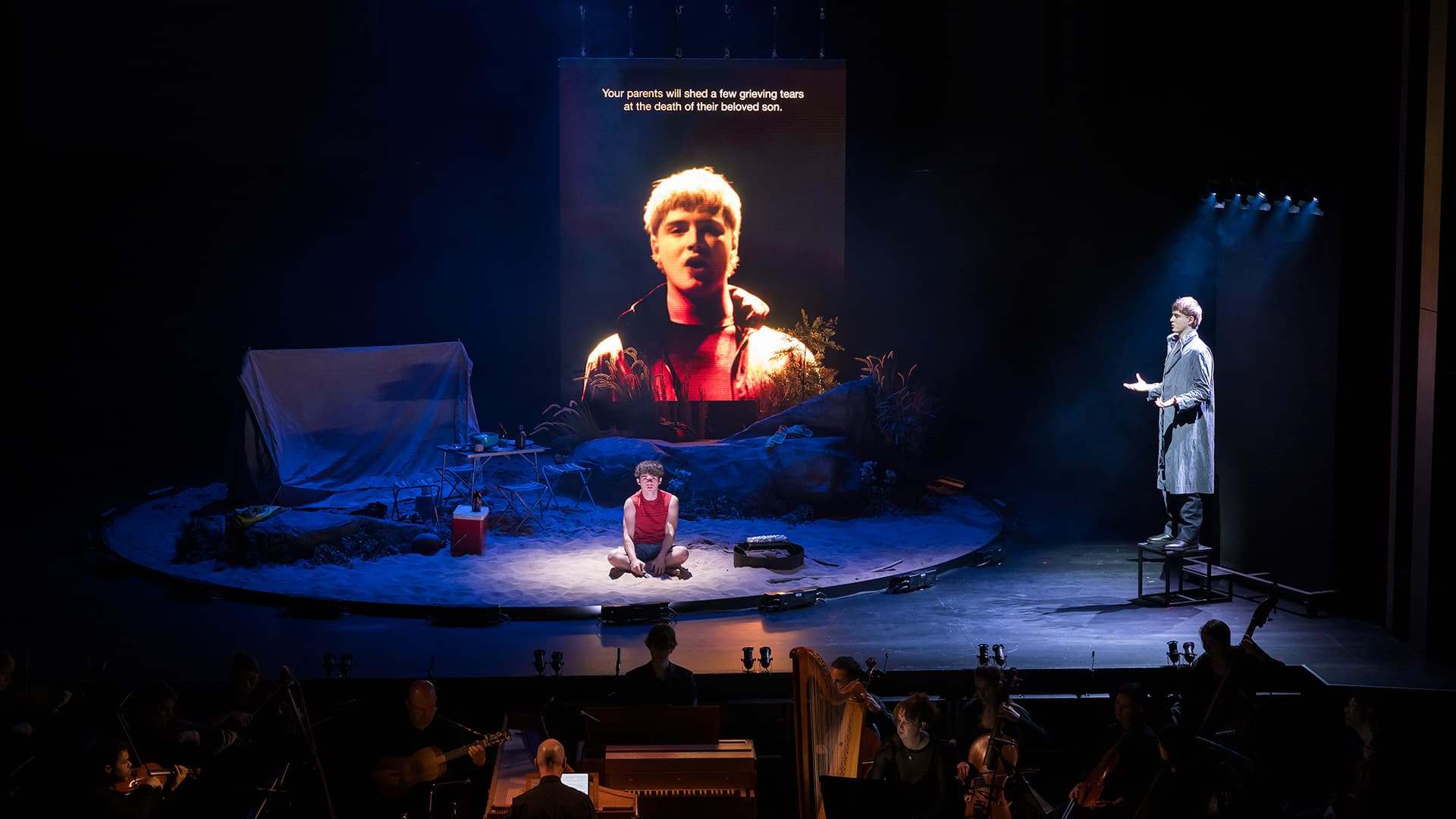
Helyard never apologises for such formulaic construction in his performance of Baroque operas. In The First Murder, this respect for formula was enhanced by the staging created by the director, Dean Bryant. Jeremy Allan's set was the desert into which Adam and Eve were expelled from the garden of Eden, plus some very skilfully used flats onto which were projected live videos of God and Lucifer. The movements, directed by Shannon Burns, were often slow and stylised. But the piece of formulaic brilliance of Bryant’s conception was having the parts of Cain and Abel played by actors (Ewan Herdman and Ty Arnott), but sung by the gorgeous voices of Ashlyn Tymms and Madison Nonoa. This doubling of the stage characters, while quite formal, was not at all mechanical, unlike for example Peter Greenaway’s tripling of some characters in Andriessen's opera Writing to Vermeer. Both the Cains were dressed in red, and both Abels in blue. But the movements of the singers on stage, while relating to the actions of the dancers, never copied them, but was always a tactful underscoring of the emotions behind the action, much as music is the emotional embodiment of what is described in text. This effect is wonderful, and the production is worth seeing just for this.
As always with Pinchgut, the cast sings beautifully, without a weak link. I could hear every word of Ashlyn Timms’ part, and Madison Nonoa’s crystalline purity of sound carried to the back of the theatre even in the softest of pianissimo. Sara Macliver used all her immense expressive power to depict Eve’s shame. In his opening aria, Figli, miseri figli, Kyle Stegall’s coloratura announced the virtuosity of all the singers. Stephanie Dillon sang impressively as God, and it was of course refreshing to have God portrayed as a woman. Freddie Shaw’s Lucifer, with the snarling regal, was a menacing blend of coercion and persuasion in his glorious bass voice. And the many duets between Cain and Abel, and Adam and Eve, were pure delight.
A perhaps controversial aspect of the production was Bryant’s decision to present the first act as a family picnic on a beach. While it could possibly be asserted that one of the punishments associated with the Fall might be sand in one’s sandwiches; and, with some basis in Genesis 4, that having a discordant family was another consequence of it, I found myself unsettled by the VBs until I read the director’s note about his own origins in a different Eden, the town on the south coast of NSW. But much more perturbing was the thought that the convict settlers, having been expelled from England’s “green and pleasant land” (as Blake described it in a poem contemporary with the sailing of the First Fleet) might have washed up on Bondi Beach…
My misgivings about the plastic beach buckets were shared by many, though not all, of the audience members I spoke with in the interval. And it was certainly a relief to see that the set had been stripped of all beach references for the second act. This act rose in intensity even past the actual murder, and my attention only flagged, despite Dillon’s best efforts, in God’s interminable aria Adam, prole tu chiedi. This aria made me reflect on the one single way in which the fertile pursuit of historically informed performance practice is not pursued by Pinchgut: they almost never make cuts to the originals.
There were many graceful stage connections between the first and second act. Abel reconstructs the lamb which was burnt (yes, actually burnt on stage) in the first act; then Cain cradles it lovingly as part of his remorse for the murder. Cain reconstructs the driftwood structure Abel made on the beach, which Cain had destroyed in a fit of rage in Act 1.
And then – a stroke of genius. Instead of finishing with Scarlatti’s somewhat half-hearted attempt at a happy ending (don’t worry, the Redeemer will come) the production team closed the opera with a heart-wrenchingly beautiful slow movement from one of Scarlatti’s concerti grossi as Cain’s remorse undoes him. Just as when any of us lose one of our children, there is no Hollywood ending to the Fall.
The First Murder is one of Pinchgut’s most remarkably successful productions. Grab one of the few remaining tickets if you haven’t already.
Event details
Pinchgut Opera presents
The First Murder (Il primo omicidio)
by Alessandro Scarlatti
Director Dean Bryant
Venue: Roslyn Packer Theatre, Walsh Bay NSW
Dates: 23 – 31 May 2026
Bookings: www.pinchgutopera.com.au